Paint Grade vs Stain Grade Millwork: How Shops Decide
By Aman Pratap · · 6 min read · Millwork Finishes
Walk through any millwork shop and you will hear the same two phrases: paint grade and stain grade. They sound like finish choices, but the grade quietly decides what wood the shop buys and what the job ends up costing, before a single board is cut. Here is what each grade actually means, how shops make the call, and how the decision gets written down so it survives the trip from design meeting to spray booth. Every example below comes from our own drawing sets.
What paint grade means
Paint grade means the wood will disappear under an opaque coating. Nobody will ever see the grain, so the material does not need to be pretty. It needs to be smooth and stable, and it has to hold paint well. That is why paint grade work is usually built from poplar, soft maple, or MDF, and why small defects are fine. They get filled and sanded away.
Here is a real example from a kitchen we drafted. The cabinet interiors are pre-finished maple plywood, and the exteriors are painted in Benjamin Moore HC-172 Revere Pewter:
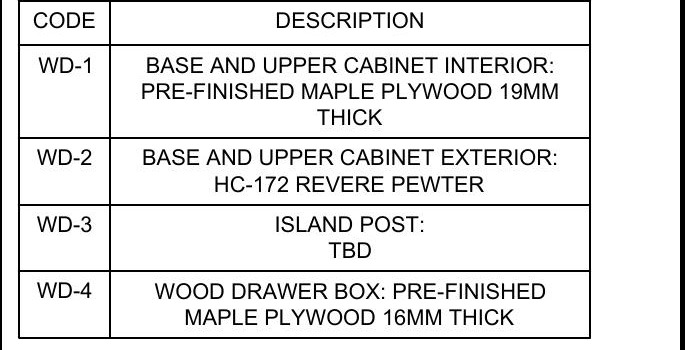
Notice how it works. Every finish gets a code (WD-1, WD-2), and every panel on every elevation carries one of those codes, so the painter never has to guess which surface gets which treatment. Our millwork drafting team builds this code system into every set, otherwise the shop floor ends up interpreting instead of building.
What stain grade means
Stain grade is the opposite bet. The grain is the whole point, so the wood itself has to be chosen carefully: clear boards of oak, walnut, or cherry, or matched veneer, finished with stain or a clear coat that lets the figure show. There is no hiding anything. A filled nail hole that would vanish under paint shows forever under a clear finish.
On high-end commercial work, stain grade gets specified down to the veneer batch. This material schedule is from a corporate headquarters project we drafted:
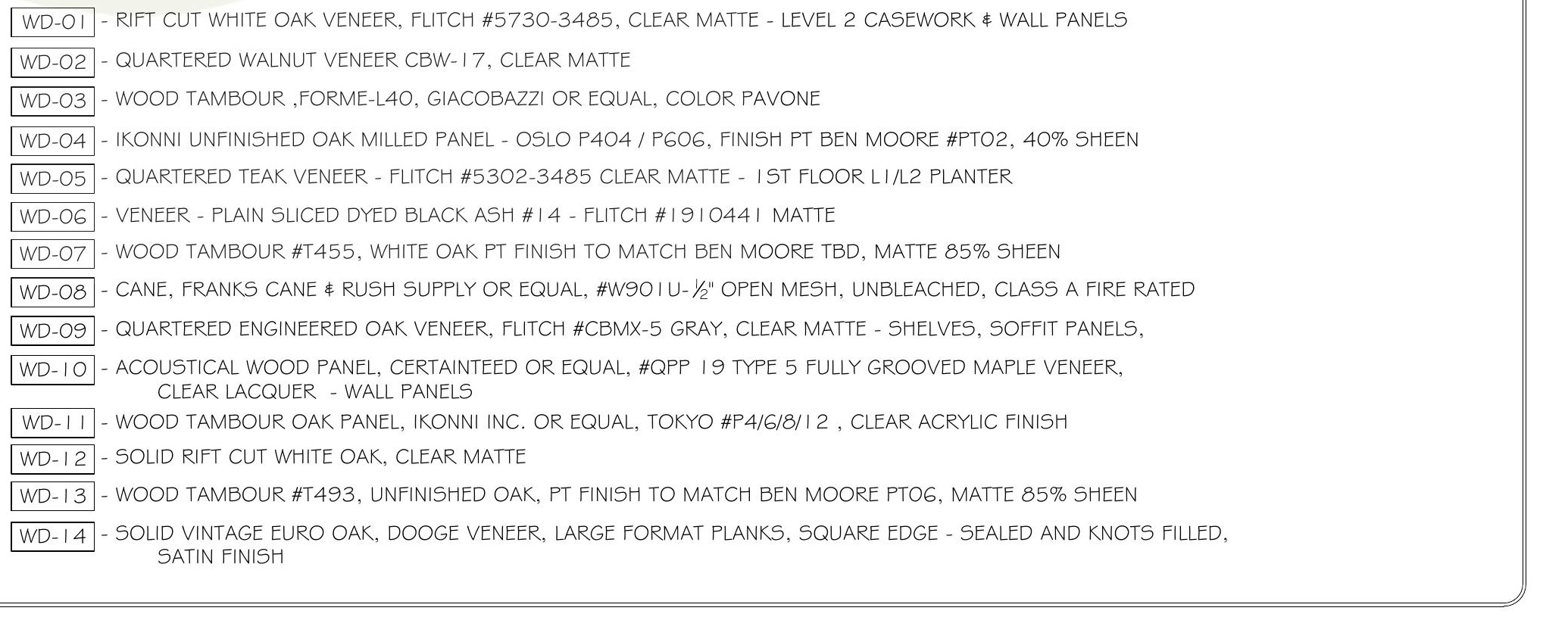
Look at WD-01: rift cut white oak veneer, flitch #5730-3485, clear matte. A flitch is the numbered bundle of veneer sheets sliced from one log. Calling out the flitch number means every panel in the room comes from the same log. On a long wall, that is the only way the grain lines up.
How shops actually decide
The design decides first. If the room calls for solid color, it is paint grade. If it calls for wood character, it is stain grade. After that, the choice is mostly money and risk.
Stain grade costs more in material. Select hardwoods and matched veneers carry a real premium, and a mistake is expensive because damaged grain cannot be patched invisibly. Paint grade saves on material but gives some of that back in labor: filling, priming, and extra topcoats to get a furniture-quality painted surface.
In our experience across hundreds of manufacturer clients, it usually lands like this: paint grade when the design wants a solid color on a workable budget, stain grade when the client is paying to see real wood. Both are fine choices. Problems start when the grade is assumed instead of written down.
The finish schedule: where the decision gets locked
Every drawing set we deliver carries a finish or material schedule, and this small table is what keeps the paint grade vs stain grade decision from turning into an argument. Here is one from a custom buffet project:
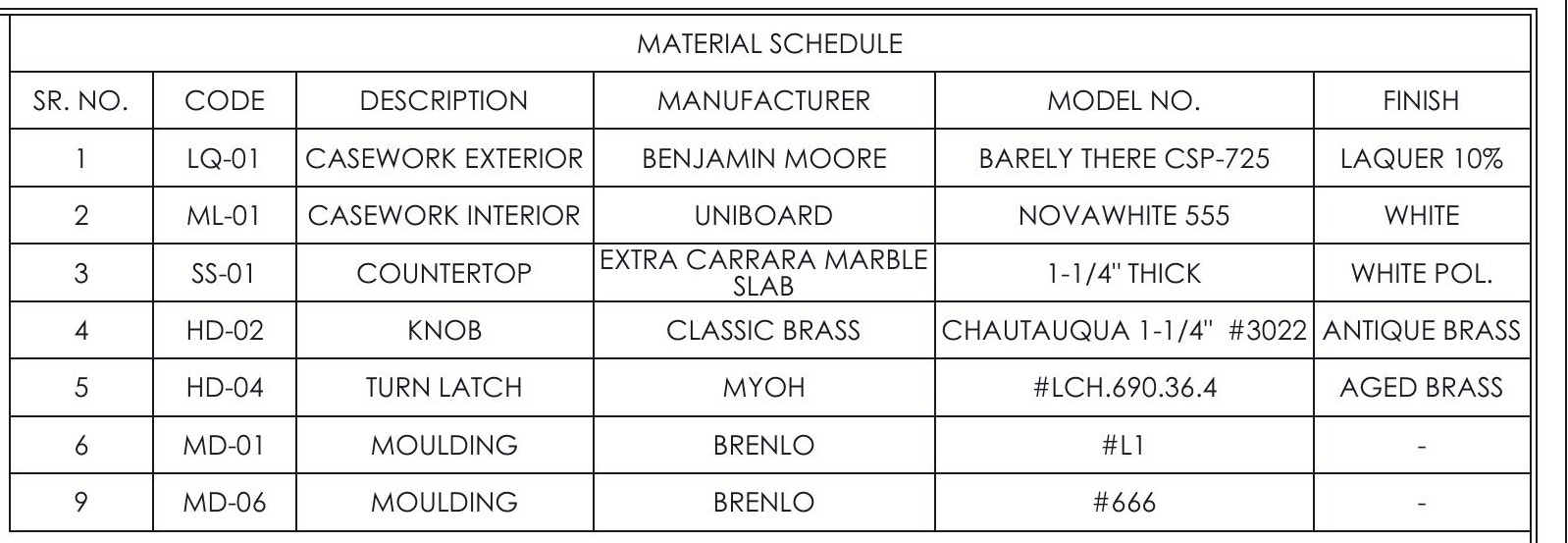
Read the first row. LQ-01, casework exterior, Benjamin Moore, Barely There CSP-725, lacquer at 10 percent sheen. Not just "painted white": a manufacturer, a product code, and a sheen. When the finish is written at that level, the shop, the painter, the designer, and the client are all looking at the same color, and nobody repaints a buffet over a misunderstanding.
We walked through a complete drawing set, finish list included, in our kitchen cabinet shop drawings walkthrough if you want to see where this table sits in a full package.
If you are specifying or bidding millwork
Two takeaways. If you design or build: name the grade and the exact finish in writing before anyone prices the job, because switching a kitchen from paint grade to stain grade mid-project reprices the material, the labor, and the schedule. If you run a shop: be careful quoting from drawings that just say "painted" or "stained," because the gap between a 10 percent sheen lacquer and a two-coat site paint job is your margin.
Need drawing sets with finish schedules the shop floor can actually build from? Send us your project for a free quote and we will show you what your drawings look like with every finish pinned down.
About the author
Aman Pratap is the Founder and CEO of A2Z Millwork Design LLC. Since founding the firm in 2020, he has grown it into a team of more than 100 drafters serving over 400 millwork manufacturers across the US, Canada, and Australia, with 500-plus projects delivered to AWI and AWMAC standards. In 2025 he was named to Woodworking Network's Wood Industry 40 Under 40 for transforming A2Z Millwork Design into a premier CAD millwork drafting partner known for precision and faster project turnaround.
FAQ's
Is paint grade cheaper than stain grade?
Usually yes on material, because poplar and MDF cost far less than select oak or matched walnut veneer. Some of the savings go back into prep labor, since painted surfaces need filling, sanding, and priming. One trick you will see in our sets: painted exteriors often pair with pre-finished plywood interiors, which saves the shop a full finishing step on every cabinet box.
Can MDF be stain grade?
No. MDF has no grain, so there is nothing for stain to show. The same goes for finger-jointed stock: the short glued segments telegraph straight through stain but disappear completely under paint. If a drawing specs MDF or finger-jointed material, it is a paint grade job by definition.
Can one project mix both grades?
Yes, and big projects almost always do. The corporate set shown in this post carries custom lacquer woodwork codes and clear-matte oak veneer codes in the same material schedule. The code system is what makes mixing safe: each panel points to its own finish, so painted and stained parts sit side by side without confusion.
What sheen should millwork paint or lacquer be?
There is no single answer, which is why good drawings state it per item. Across our sets you will see everything from 10 percent sheen on a formal buffet to 40 percent on commercial oak panels. Lower sheen hides touch-ups and surface waves better, while higher sheen cleans easier and reads more commercial.