How Millwork Estimating Services Work: Process and Costs
By Aman Pratap · · 7 min read · Estimation
Every millwork bid starts the same way: a drawing set lands on a desk, and someone has to turn it into a number. Count every cabinet, measure every run of trim, price every sheet of plywood and every hinge, add the labor, and do it fast enough to hit the bid deadline. That work is estimating, and more shops are handing it to a dedicated service instead of doing it at midnight after the shop floor closes.
This guide explains how outsourced millwork estimating and takeoff services actually work: what you send, what happens to it, what comes back, and what it costs. If you have never used one, this is the full picture before you send your first drawing set.
What a Millwork Estimating Service Actually Does
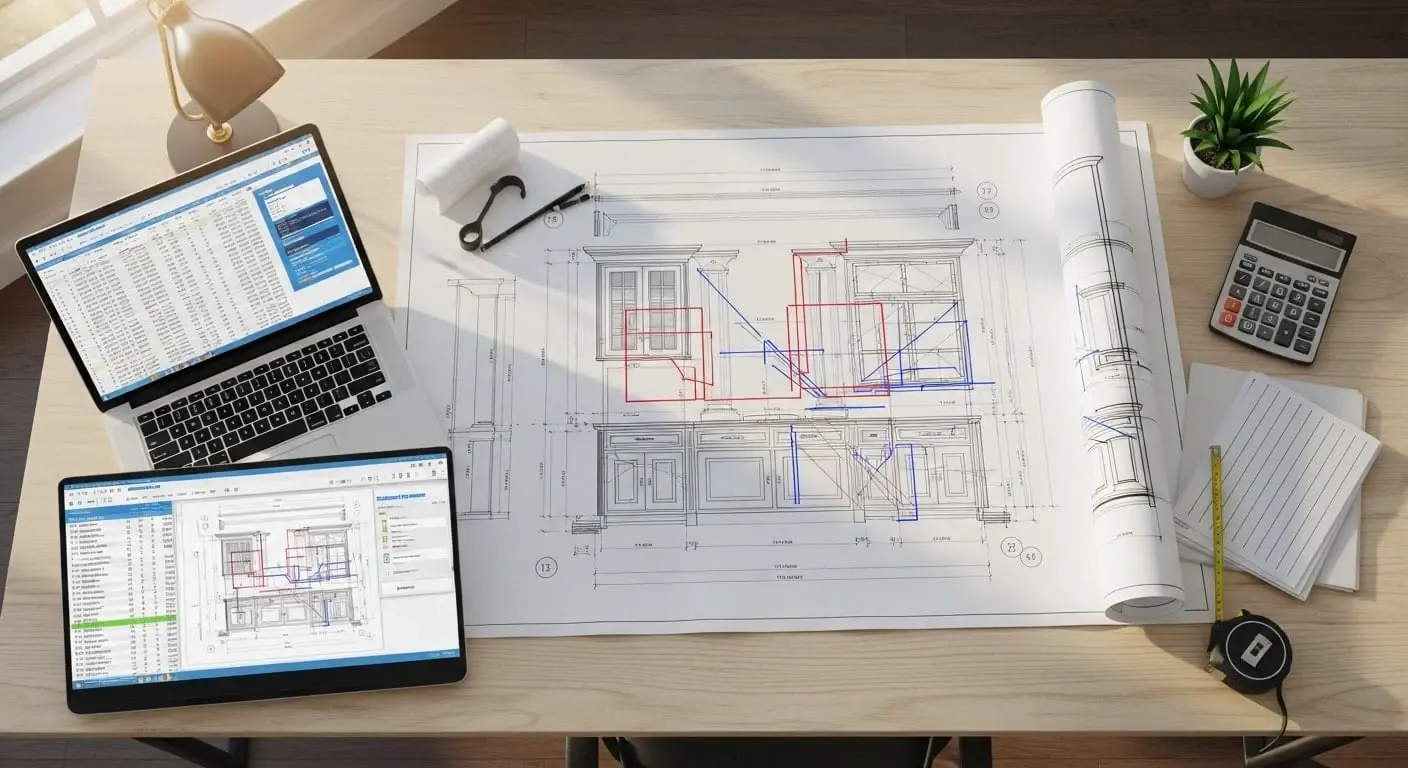
The service does three things. First, a quantity takeoff: reading the architectural drawings and millwork specifications, then measuring and counting every millwork item in the project, from casework boxes to trim runs to hardware. Second, pricing: applying current material costs, waste factors, and fabrication and installation labor to those quantities. Third, packaging: assembling it into an itemized estimate you can drop into your bid, defend in a negotiation, and hand to purchasing if you win.
The important part is what it does NOT do. An estimating service does not decide your margin, your markup, or your final bid price. It gives you the cost picture; the business decision stays yours.
The Process, Step by Step
1. You send the drawing set
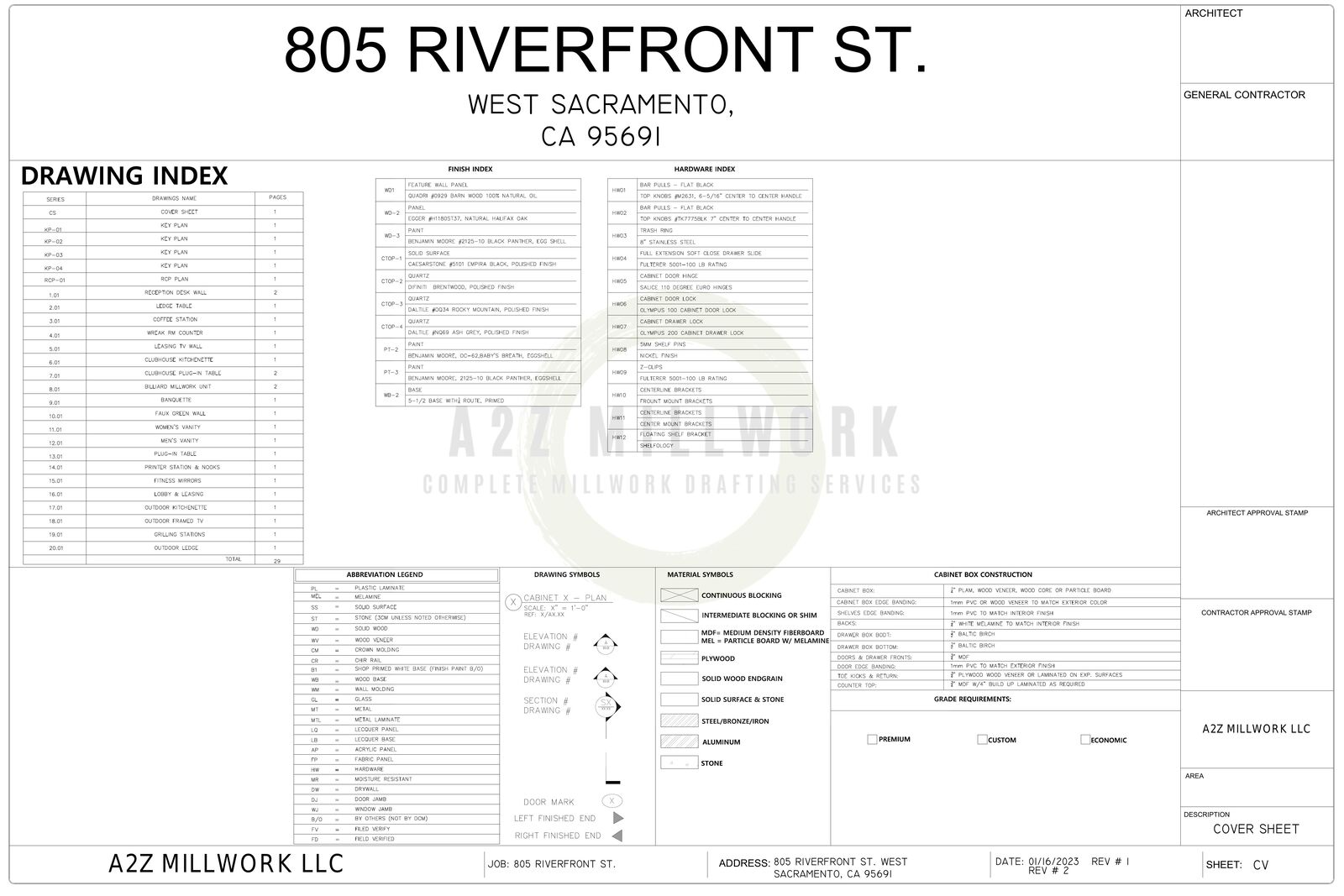
Architectural drawings, millwork drawings if they exist, finish schedules, and the spec sections that touch millwork. PDFs are the working standard. The more complete the set, the tighter the estimate, but a good estimator will work from what exists and list assumptions for what does not.
2. The quantity takeoff
This is the core of the work. The estimator goes through the set sheet by sheet, usually in digital takeoff software like Bluebeam Revu, measuring lengths, areas, and counts directly on the drawings. Every measurement is marked up on the sheet itself, which matters later: when a number looks odd, you can trace it back to exactly where it came from instead of arguing about a mystery figure.
3. Material pricing
Quantities become costs: sheet goods by the sheet with waste factors applied, solid wood by the board foot, hardware by the piece from the hardware schedule, finishes by the square foot. Current pricing matters here, because material prices move, and an estimate built on last year's plywood price is wrong before it leaves the building.
4. Labor estimation
Fabrication hours for the shop, installation hours for the field, drawn from the complexity of each item. A flat slab of plastic laminate countertop and a radiused reception desk with integrated lighting are both one line item, but they carry very different hours, and this is where millwork-specific experience separates a real estimate from a spreadsheet exercise.
5. The estimate comes back
What you should receive is an itemized document: line items by area or drawing sheet, quantities with units, material and labor split out, stated assumptions, and an explicit exclusions list. If a service hands you a single lump sum with no breakdown, that is not an estimate, that is a guess with confidence.
What Millwork Estimating Costs
There are two honest ways to look at the cost: what the work costs to buy, and what the alternative costs to staff. Estimating services generally price per project, per sheet, or hourly. Per project suits defined bid packages. Per sheet gives predictability on large sets. Hourly fits ongoing overflow arrangements. Any real quote depends on the size and complexity of your drawing set, which is why serious providers quote after seeing it, not before.
The staffing alternative has a public price tag. According to the US Bureau of Labor Statistics, the median cost estimator earned $78,740 per year as of May 2025, before benefits, software seats, and training. For a shop that bids in waves rather than continuously, that fixed cost is exactly what outsourcing converts into a per-bid expense.
$78,740 - median annual wage for cost estimators (BLS, May 2025). 3% - projected decline in estimator employment 2025 to 2035, while replacement demand continues.
In-House or Outsourced?
In-house wins when you bid constantly, your work is repetitive enough that historical numbers carry most jobs, and the estimator can double as a project engineer between bids. Outsourcing wins when bids come in waves, when your estimator is your bottleneck during bid season, or when the owner is doing the estimating personally at night. Many shops run a hybrid: in-house for repeat work, a service for overflow and for large commercial sets. If you want to understand the mechanics deeper before deciding, the step-by-step math is covered in our guide on how to estimate millwork.
The Failure Points a Good Service Protects You From
- Missed scope hidden in notes: the blocking, the fire treatment, the field verification called out in a drawing note nobody priced.
- Outdated price data: material and hardware costs move every quarter, so ask any provider how current their pricing sources are before you rely on the number.
- Ignored site conditions: freight elevators, occupied buildings, and after-hours installation windows all change labor.
- Manual takeoff errors: counting from paper without markups makes quantities untraceable, so errors survive review.
- No exclusions list: what an estimate leaves out matters as much as what it includes, and unstated exclusions become disputes.
These failure points are also the checklist for choosing a provider. Ask to see a sample estimate. Look for itemized lines, drawing-sheet references, stated assumptions, and an exclusions list. Ask what software the takeoff runs in. And ask whether the estimators actually know millwork, because someone who has priced casework, custom millwork packages, and hardware schedules will catch the scope items a general construction estimator walks past.
See What a Bid-Ready Estimate Looks Like
Send us a drawing set and get back an itemized estimate with every quantity traceable to a sheet: materials, labor, assumptions, and exclusions all stated. NDA available, no obligation. Request a free quote and we will get back to you within one business day.
About the author
Aman Pratap is the Founder and CEO of A2Z Millwork Design LLC. Since founding the firm in 2020, he has grown it into a team of more than 100 drafters serving over 400 millwork manufacturers across the US, Canada, and Australia, with 500-plus projects delivered to AWI and AWMAC standards. In 2025 he was named to Woodworking Network's Wood Industry 40 Under 40 for transforming A2Z Millwork Design into a premier CAD millwork drafting partner known for precision and faster project turnaround.
FAQ's
How long does an outsourced millwork estimate take?
It scales with the drawing set. A defined casework package of a few sheets typically turns around in a couple of business days, while a full commercial set with dozens of millwork sheets can take a week or more. Serious providers commit to a delivery date when they quote the job, so the timeline is agreed before work starts.
What software do millwork estimating services use?
Digital takeoff runs in tools like Bluebeam Revu, with quantities exported to structured spreadsheets for pricing. Some providers also work in dedicated takeoff platforms such as Planswift or On-Screen Takeoff. The software matters less than the markup discipline: every measured quantity should be visible as a markup on the drawing itself.
Is it safe to send bid drawings to an outside estimator?
Reputable services work under NDA on request and treat bid documents as confidential by default. Bid sets are already distributed to multiple subcontractors during any tender, so the practical risk is low, but an NDA formalizes it. Ask for one if the project is sensitive.
Do estimating services also do the takeoff for materials purchasing?
Yes, and it is the same underlying work. A bid-stage takeoff prices the job; if you win, the same quantities become the procurement list. Some shops order estimates specifically to generate purchasing quantities on jobs they have already won, separate from any bid.
What does an estimating service need from me to start?
At minimum: the architectural drawing set, relevant spec sections, and the finish and hardware schedules if they exist. Helpful extras are the bid due date, any known site constraints, and your preferred breakdown format so the estimate lands in a structure your bid template can absorb directly.